- paolabiologist
- Oct 30, 2025
- 2 min read

Sea Ice forms seasonally across the Ross Sea during the Winter months in Antarctica. Every year brings a unique landscape, and with it new formations and cracks. As the sea surface starts to freeze, we can observe frazil ice begin to form. Depending on the wind stress over them, they can take the texture of an icy drink, called Nilas ice, or a form of pancakes called, wait for it, pancake ice!


Left: McMurdo Sound (red pin) during Summer season 2025; Right: McMurdo Sound during Winter Sound 2025. Both images from NASA WorldView.
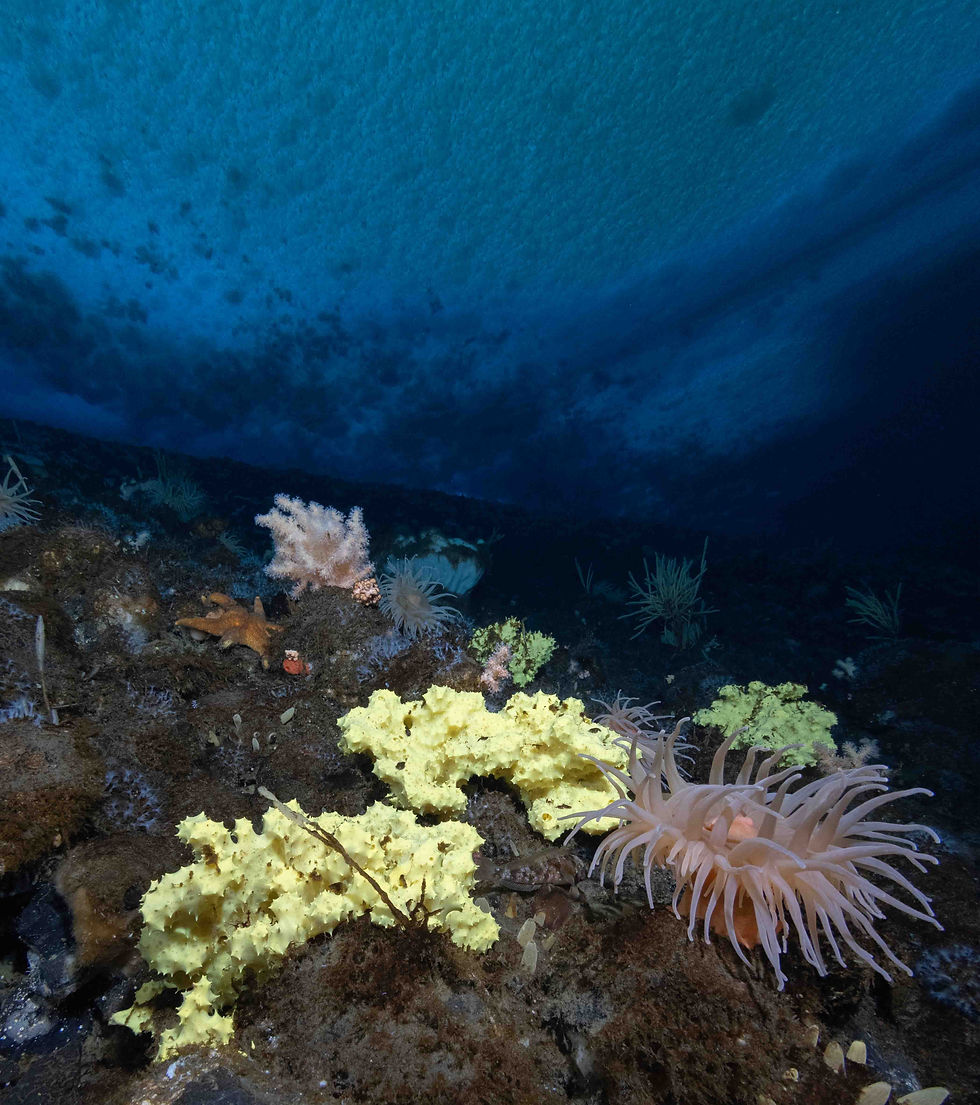
As the ice accumulates, it can thicken over 5 feet easily! Now called columnar ice, it is usually paired with stalactites-looking ice underneath called platelet ice (although this fragile ice below is not considered part of the ice true thickness).

Below the sea ice, platelet ice formation in the McMurdo Sound.
As ice sheets collide into each other, they form pressure ridges between them - which leads to cracks. Due to the cool geometry of ice molecules, working cracks usually expand in a stair like pattern. The start of the stair like feature marks the actual crack width, while the crack width that it is unreliable to cross due to little sea ice thickness is considered the effective crack width. To safely cross them, either by foot or by our vehicles like the Pisten Bully, we dig them up and profile them!

A cool trick to spot sea ice cracks: look for the seals! Seals love the cracks as a way to get in and out of the water - where there is a seal, there must be a crack.
To profile a sea ice crack, we dig into the snow until we hit ice. Starting from the crack itself, we dig outward until we find the first “stair” step. Once we found ice, our goal is to get:
Actual and Effective crack width
Ice Thickness

On the crack itself, we drill (see the picture below!) until we hit water. The drill itself is 100cm, so if no water is touched, we are good to pass it! If it does, we proceed to measure the sea ice thickness with a measuring tape through the hole.
How do we know what is the minimum thickness? We have a handy little table! Depending of the vehicle you are driving, different minimum values for thickness and width will exist to ensure a safe passage of the vehicles.


For our Pisten Bully vehicle we require at least 12in of ice thickness with an effective crack width of no more than 36in. Because we found less than 12in of thickness, we moved outward the crack in 1ft increments and drilled again. With each drill, we were expanding our effective crack width. If the drilling went past 36in without getting a thickness of more than the 12in, it would not have been safe to cross. Lucky for us, we were able to find a thickness of more than 12in within a length of 36in, safe to cross!
No year or day is the same. Cracking the code on the cracks is a daily effort from anyone that passes its way!